
Reserve Bank Governor Sanjay Malhotra on Friday said the key policy rates will remain at low levels for a long period and may go down even further.

Rating firm Crisil revised downwards its GDP growth forecast to 5.5 per cent this fiscal from its earlier estimate of 6 per cent, citing reduced likelihood of monetary easing going forward due to falling rupee.
Global credit rating agency Standard & Poor's on Thursday said India's economic growth may fall marginally to 7.5-8 per cent, but inflation outlook remained stable at 5-5.5 per cent in 2007.

"The Monetary Policy Committee recognises that there is monetary policy space for future action. However, given the evolving growth-inflation dynamics, the MPC felt it appropriate to take a pause at this juncture," the RBI said in its fifth bi-monthly monetary policy for this fiscal.

Describing the current level of inflation as "unacceptable", Chief Economic Adviser in the Finance Ministry Kaushik Basu on Thursday indicated the government will revise downward the growth forecast for 2011-12.
With improved prospects for the farm sector, Centre for Monitoring Indian Economy on Friday raised the economic growth forecast for 2005-06 to 6.8 per cent from the earlier six per cent.

S&P Global Ratings on Monday retained its forecast of 9 per cent contraction in the Indian economy for the current fiscal, saying even though there are now upside risks to growth but it will wait for more signs that COVID infections have stabilised or fallen. S&P, in its report on Asia Pacific, projected the Indian economy to grow at 10 per cent in the next fiscal.

SBI Research has projected the Indian economy to grow at 7.5 per cent in 2022-23, an upward revision of 20 basis points from its earlier estimate. As per official data, the economy grew by 8.7 per cent in FY22, net adding Rs 11.8 lakh crore in the year to Rs 147 lakh crore, the report said, adding this was however only 1.5 per cent higher than the pre-pandemic year of FY20. "Given the high inflation and the subsequent upcoming rate hikes, we believe that real GDP will incrementally increase by Rs 11.1 lakh crore in FY23. "This still translates into a real GDP growth of 7.5 per cent for FY23, up by 20 basis points over our previous forecast," SBI chief economist Soumyakanti Ghosh said in a note on Thursday.

Bullish over robust fundamentals and improving macroeconomic conditions, industry leader Deepak Parekh on Saturday said India currently has "exceptionally good conditions" in place to aspire for 10 per cent economic growth but much needs to be done to achieve that target.
Despite the rash of reform steps announced over the weekend, Standard Chartered India on Monday sharply lowered its GDP growth forecast to 5.4 per cent for FY'13 from 6.2 per cent earlier, citing slowing consumer demand, an anaemic industry and a weak services sector.

Chief Economic Advisor Krishnamurthy Subramanian said India's economy will witness a decline in the current fiscal, but the drop will be limited if there is an economic recovery in the October-March period.
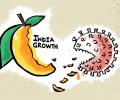
Those hardest hit by the second wave of the pandemic have been blue-collared workers, doctors and healthcare workers, law and order and municipal personnel, individuals eking out daily livelihood, and small businesses. And there should be more measures taken to alleviate their pain, the Reserve Bank of India (RBI) said on Monday. The report also indicated that the RBI's growth numbers might have to be revisited as the central bank's real GDP growth projection of 26.2 per cent given in the MPC's resolution of April 7 for the first quarter of 2021-22, were "made before the full fury of the resurgence." Nevertheless, the "resurgence of COVID-19 has dented but not debilitated economic activity in the first half of Q1: 2021-22.
Moody's Investors Service on Friday slashed its estimate of India's GDP growth during the 2020 calendar year to 2.5 per cent from an earlier estimate of 5.3 per cent, on account of the rising economic cost of the coronavirus pandemic.

The global brokerage has also lowered the growth forecast to 6.8 per cent for the 2014-15 fiscal.

The NCEAR has indicated some improvement in the fourth quarter of the current financial year.

Citing the massive surge in Omicron infections and the resultant impact on overall economic activities in the March quarter, Swiss brokerage UBS Securities has revised downwards its India's growth forecast for the current financial year to 9.1 per cent from 9.5 per cent earlier. However, UBS Securities does not see the third wave impact extending to the next financial year as it has revised upwards its real GDP forecast to 8.2 per cent, up from 7.7 per cent earlier, expecting the real GDP growth to remain well above the historical average. The World Bank pegs it at 8.3 per cent, unchanged from its June assessment, saying the recovery is not broad-based yet.
The Centre for Monitoring Indian Economy on Thursday revised growth forecast for the country's economic growth upwards to 6.2 per cent in 2004-05 as against earlier estimate of six per cent.
NCAER has pegged the growth rate between 4.9 and 5.2 per cent, led by healthy projections in the industrial output and services sector.
Investment bank JPMorgan has cut the GDP growth forecast for India for 2008-09 to 7 per cent from 7.5 per cent previously, citing expected moderation in industrial and service sector growth. The International Monetary Fund and Crisil have projected 8.2 per cent and 8.5 per cent GDP growth respectively. 7% is the lowest growth forecast for 2008-09 so far. JPMorgan said cut in growth expectations for India was due to US slump. It expects RBI to cut repo rate by 25 basis points.

In the first quarter of FY14, real GDP growth estimated by the Central Statistics Office stood at 4.4 per cent on a factor cost basis, and at 2.4 per cent on a market price basis, the IMF said.
.jpg)
The RBI said lead indicators point to continuing sluggishness in domestic economic activity in the first quarter of 2014-15.

The size of the GDP in the second quarter of 2018-19 is estimated at Rs 33.98 lakh crore, as against Rs 31.72 lakh crore a year ago
Financial services major BNP Paribas on Wednesday cut India's GDP growth forecast for the current fiscal to 3.7 per cent from 5.7 per cent earlier, saying the country's 'macro muddle' is fast approaching crisis proportions.

The economists, who were surveyed, also felt it will take time for banks to make any further reduction in deposit rates

S&P Global Ratings on Tuesday said the Indian economy is set for "resilient growth" in 2025 and projected inflation pressure to recede which will lead to "modest" easing of the monetary policy by the RBI. In its India outlook for 2025, S&P also retained India's growth forecast for current fiscal at 6.8 per cent, followed by 6.9 per cent growth in 2025-26.

Credit rating agency Crisil observed in its report that some 'high frequency indicators go out of whack' as credit growth and service tax collections are not in tune with the CSO's growth projections.

Economic growth is likely to plummet to a multi-decade low of 1.6 per cent in fiscal year 2020-21 due to the Covid-19 pandemic and ensuing measures like lockdowns and social distancing, an American brokerage said on Wednesday in one of the bleakest forecasts on GDP yet. Indian policymakers have not been aggressive enough in their response till now to the crisis, and will need to eventually intensify their efforts, economists at Goldman Sachs said.
Economic think-tank National Council of Applied Economic Research expects India's Gross Domestic Product growth to decelerate to 8.3 per cent during current fiscal

The Reserve Bank of India on Wednesday retained its growth projection at 7.2 per cent for the current fiscal on the back of improvement in urban demand and gradual recovery in rural India. Unveiling the third monetary policy for the current fiscal, RBI Governor Shaktikanta Das said the Indian economy remained resilient, and the central bank will continue to support growth. The RBI expects growth in the first quarter of the current fiscal at 16.2 per cent, which will taper to 4 per cent by the fourth quarter.

The agency had in May projected an economic growth between 7.7 and 8 per cent for this fiscal and Monday's revision comes within a week of rival Fitch Ratings, and Citigroup revising the same to 7.5 per cent from 7.7.

The country's gross domestic product (GDP) growth is likely to be 8.8 to 9 per cent in the current financial year, driven by agriculture and industry sectors, Care Ratings said in a report. The country's economy had contracted by 7.3 per cent in fiscal 2020-21. The agency said the outlook for the Indian economy on almost all counts in FY22 would look seemingly better than FY21 on account of the negative base effect.

From the Sensex firms, Tata Motors jumped the most by 5.54 per cent, followed by Kotak Mahindra Bank, Trent, Sun Pharma, Axis Bank, and ICICI Bank. However, Bajaj Finance, State Bank of India, UltraTech Cement and Tata Steel were among the laggards.

'The West Asia or the Gulf crisis has shown that what we develop as national infrastructure when things are not as bad as they could be, we forget to plan for adversities.'
One of the major contributors for the decline in growth will be the monsoon deficiency, which also affects non- agricultural sectors through demand effects, RBI report said.

Fitch Ratings on Thursday cut India's GDP growth estimate by 10 basis points to 6.4 per cent for the current fiscal, but retained the projections for the next financial year, on concerns over a 'severe' escalation in global trade war. "It is hard to predict US trade policy with any confidence. Massive policy uncertainty is hurting business investment prospects, equity price falls are reducing household wealth, and US exporters will be hit by retaliation," Fitch said in its special update to quarterly Global Economic Outlook (GEO).
As he projected a grim outlook for the economy, RBI Governor said that amidst this encircling gloom, agriculture and allied activities have provided a beacon of hope on the back of an increase of 3.7 per cent in foodgrains production to a new record.

Even if there is an early agreement on a cessation of hostilities in West Asia, the price shock will not go away easily, points out A K Bhattacharya.
India's projected economic growth for 2022 has been downgraded by over two per cent to 4.6% by the United Nations, a decrease attributed to the ongoing war in Ukraine, with New Delhi expected to face restraints on energy access and prices, reflexes from trade sanctions, food inflation, tightening policies and financial instability, according to a UN report released on Thursday. The UN Conference on Trade and Development (UNCTAD) report downgraded its global economic growth projection for 2022 to 2.6 per cent from 3.6 per cent due to shocks from the Ukraine war and changes in macroeconomic policies that put developing countries particularly at risk. The report said while Russia will experience a deep recession this year, significant slowdowns in growth are expected in parts of Western Europe and Central, South and South-East Asia.

The Reserve Bank on Friday said India is poised to become the growth engine of the world as it retained the GDP projection for the current fiscal at 6.5 per cent. Unveiling the bi-monthly monetary policy review, Reserve Bank of India (RBI) Governor Shaktikanta Das said the domestic economy exhibits resilience on the back of strong demand.
